home • our technology • deposition monitoring
Deposition monitoring.
Products in a cleanroom that meets its ISO air
cleanliness class can still collect particles on critical surfaces. Airborne
counts do not show what settles on products, or when. Monitoring the particle
deposition rate at critical locations shows whether surface contamination
remains within limits and links deposition events to their cause.
A clean room is
not a clean product.
A
cleanroom classified for air cleanliness does not guarantee clean products. ISO
14644-1 classifies cleanrooms by airborne particle concentration, but particles
do not remain airborne. They deposit on critical surfaces and accumulate over
time, so the longer a product is exposed, the more contamination it collects.
Airborne particle counters give limited information on larger particles, which
settle quickly, are removed less efficiently by ventilation and are often the
critical size in cleanrooms where people work. Operators are in most cases the
largest source of these particles.
ISO 14644-17 addresses this with the particle deposition rate level (PDRL), which relates air cleanliness directly to surface contamination at critical locations. The contamination risk depends on the deposition rate, the exposed critical area and the exposure time. Increasing the air change rate is an energy-intensive way to reduce deposition. Knowing when and why particles deposit allows more targeted measures in cleaning, gowning and behavior.
Deposition monitoring is relevant throughout the life cycle of a cleanroom: during commissioning, to verify requirements under operational conditions; during daily operation, at critical workstations; after changes in layout, equipment or procedures, to assess their effect; and during root-cause analysis, when contamination is found on products.
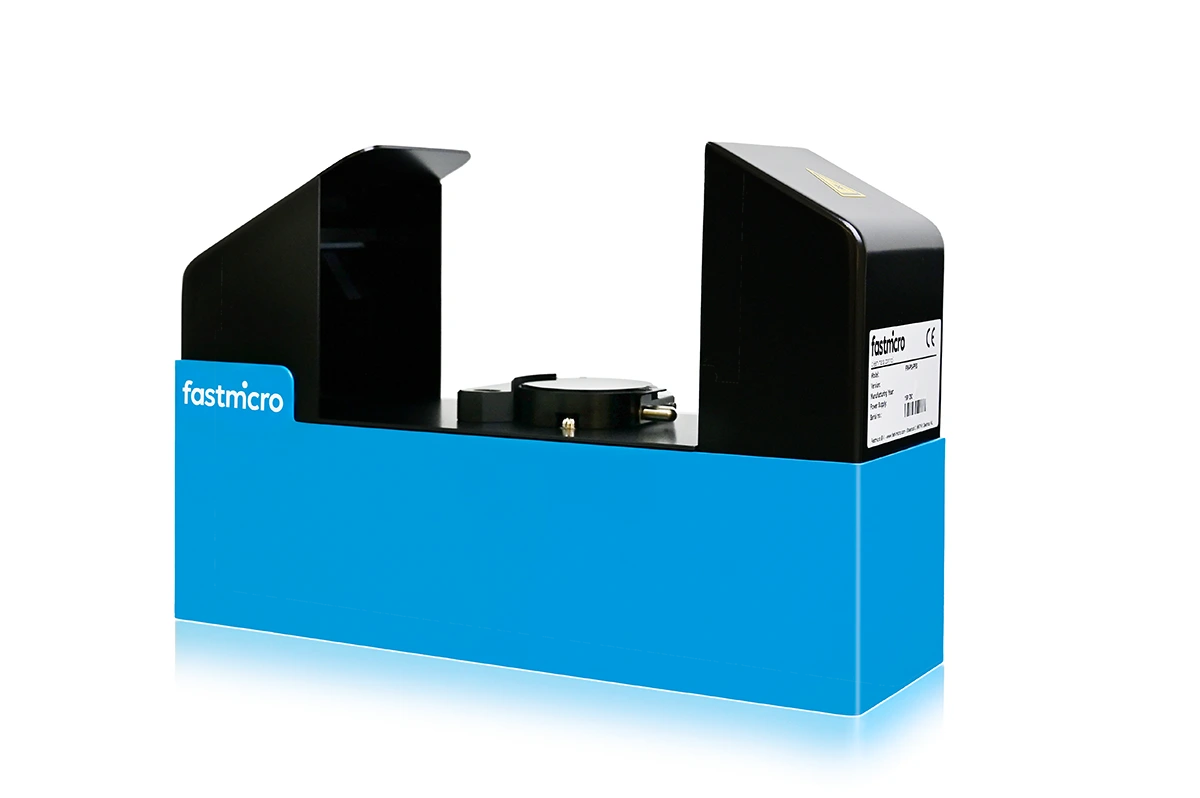
The Fastmicro Particle Fallout Scanner measures deposition directly where products are exposed, on a standard 2-inch silicon witness wafer that represents a critical product surface. It records the size, position and time of each newly deposited particle. This makes it possible to link deposition events to specific activities, such as people entering or doors opening, and to warn when defined limits are exceeded. For mapping larger areas, particle traps can be measured batch-wise, and a high-vacuum version monitors deposition inside tools. The result is a continuous, objective view of the process environment, which turns cleanroom control from assumption into evidence.
● Systems
PFS-AMB01
Particle Fallout Scanner
for measuring surface particle contamination levels within seconds,
with reliable and reproducible results.
Our products for
deposition monitoring.
Fastmicro principles.
Why our solutions work