home • knowledge base • all about yield loss
All about yield loss.
Yield loss is one of the most critical performance and cost drivers in high‑precision industries.
Particle contamination is often the most underestimated cause of yield loss. Even microscopic particles—far smaller than a human hair—can disrupt manufacturing processes, degrade product quality, and trigger cascading failures across complex systems. Particle contamination is not merely a cleanliness issue—it is a yield, reliability, and economic challenge.
Understanding its sources, controlling its spread, and optimizing inspection workflows are essential steps toward maximizing throughput and ensuring high‑quality, high‑performance outcomes.
The price of non-quality.
Yield loss carries a price far beyond scrapped units. Visible costs — tangible, measurable, directly tied to failure — are only the surface. Hidden costs run deeper: lost trust, damaged reputation, strained supplier relationships, rework-driven morale hits, root-cause investigations, and engineering changes.
read article →

Correlation between particle contamination and yield loss.
Particle contamination is a significant and well-documented cause of yield loss in semiconductor fabrication, composite aerospace manufacturing, and superconducting accelerator components. The particles involved are often microscopic, and they can enter the process from people, equipment, materials, and the environment.
read article →

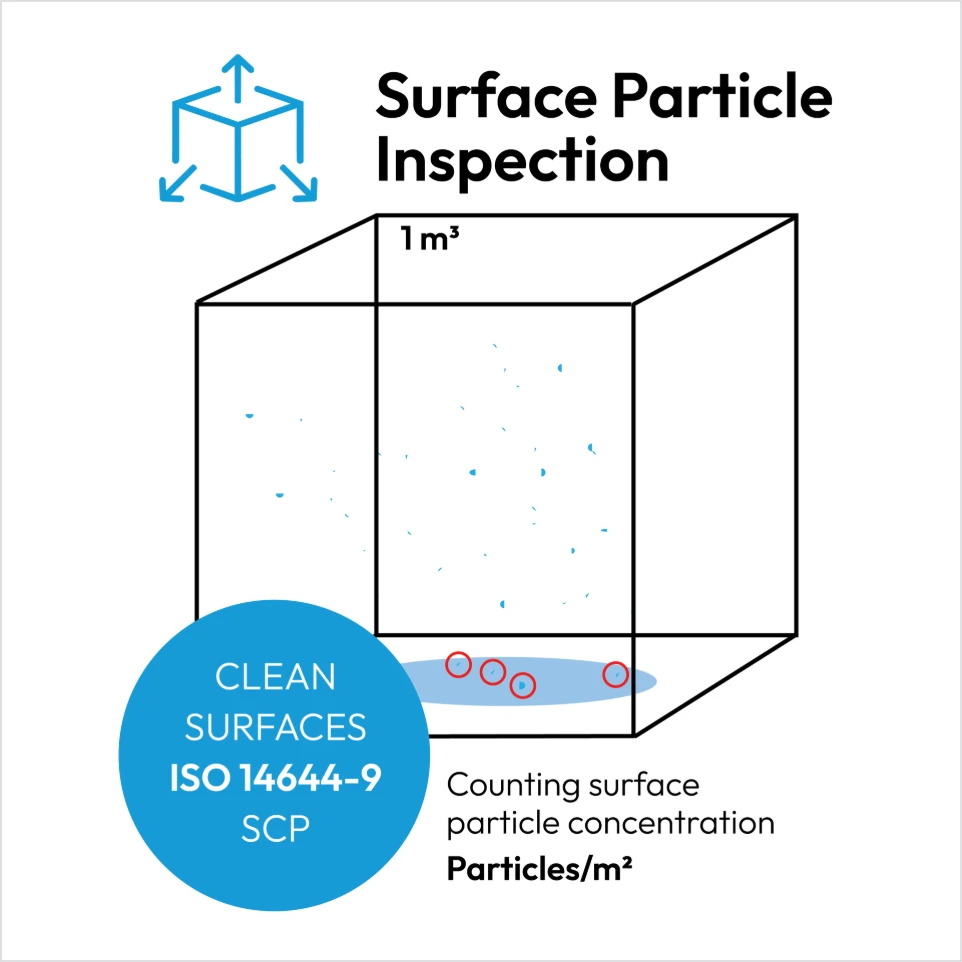
How particles move in a cleanroom.
Contamination doesn't just float — it settles, accumulates, and threatens your process. Discover how three complementary measurements, from airborne counts to surface inspection, reveal the full contamination story your cleanroom is telling, and why our systems are built to help you read it.
read article →
How to reduce yield loss.
Leading organizations with production in clean environments share one approach: they treat surface cleanliness as a measurable, controlled parameter rather than an assumption.
read article →