home • knowledge base • all about yield loss
How particles move in a cleanroom.
Contamination
doesn't just float — it settles, accumulates, and threatens your process.
Discover how three complementary measurements, from airborne counts to surface
inspection, reveal the full contamination story your cleanroom is telling.
Airborne Particle Counting
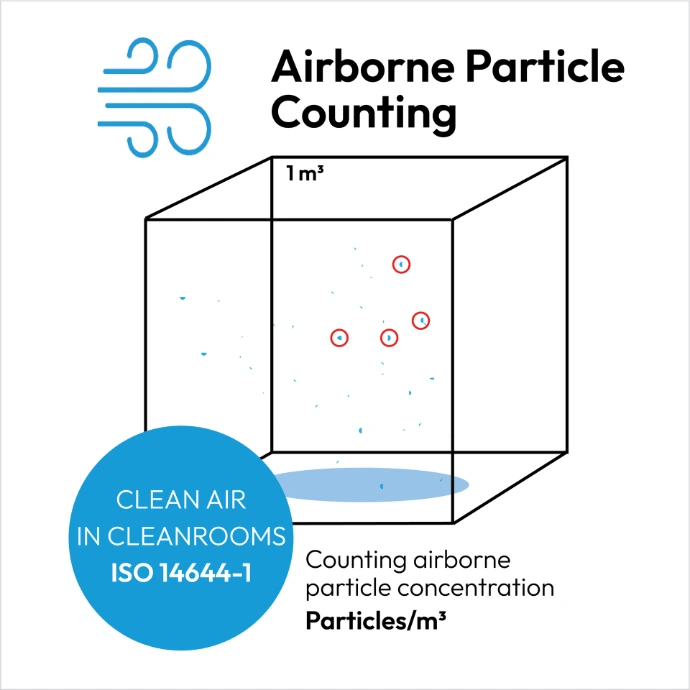
Airborne particle counting (ISO 14644-1) looks at particles still suspended in the air, counting how many are floating within that cubic meter at any given moment. This is expressed as particles per m³ and is the classic "clean air" metric — it tells you how contaminated the atmosphere itself is, before anything has settled.
Particle Fallout Monitoring
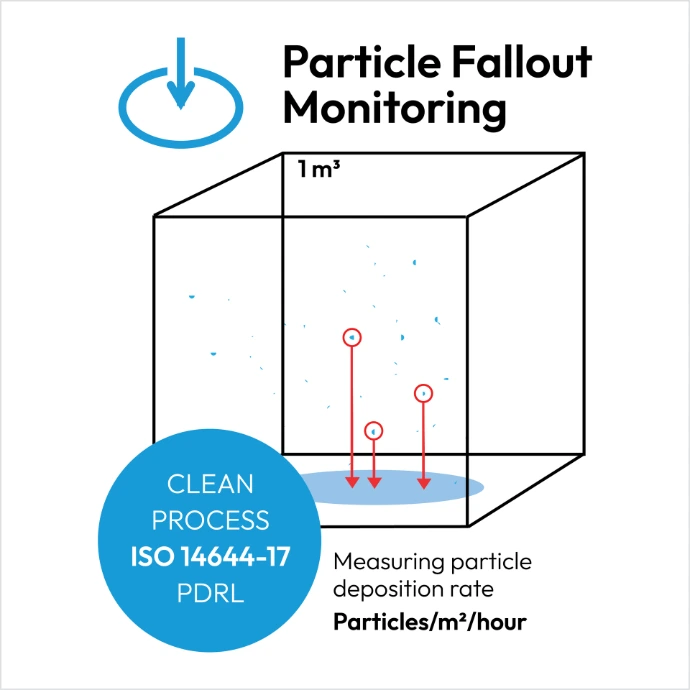
Particle fallout monitoring (ISO 14644-17, PDRL) tracks what happens next: particles that are airborne eventually succumb to gravity and drift downward onto surfaces below, as shown by the red arrows pointing down onto the collection plate. Rather than counting particles in the air, this method measures the deposition rate — how many particles land on a surface per m² per hour. This matters because it reflects the "clean process" risk: particles falling out of the air are exactly what could contaminate an open product or process below.
Surface Particle Inspection
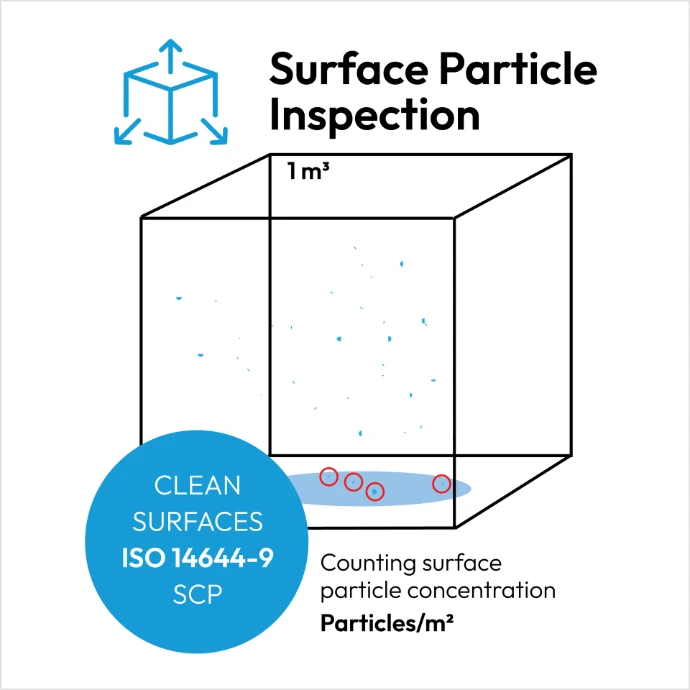
Surface particle inspection (ISO 14644-9, SCP) looks at the end state — particles that have already accumulated on a surface, regardless of when or how they got there. This is measured as particles per m² and represents "clean surfaces," a static snapshot of contamination on equipment, tools, or work surfaces rather than a rate.
In a cleanroom, particle contamination doesn't behave the same way everywhere, meaning a single measurement method is insufficient. We distinguish 3 types of particle contamination, each requiring a different form of monitoring.
So the physical story is sequential: particles exist in the air, some of them fall out and land on surfaces over time, and the surfaces themselves accumulate a standing particle population as a result. A complete contamination-control picture therefore requires not only knowing not just how clean the air is, but also how fast it's depositing particles and how clean surfaces actually end up.